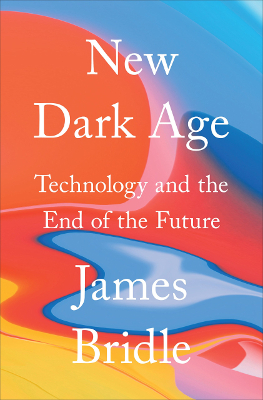
New Dark Age: Technology and the End of the Future is forthcoming from Verso in June 2018. It can be pre-ordered from Amazon (UK/US/DE) and all good bookstores.

New Dark Age Cover

We live in times of increasing inscrutability. Our news feeds are filled with unverified, unverifiable speculation, much of it automatically generated by anonymous software. As a result, we no longer understand what is happening around us. Underlying all of these trends is a single idea: the belief that quantitative data can provide a coherent model of the world, and the efficacy of computable information to provide us with ways of acting within it. Yet the sheer volume of information available to us today reveals less than we hope. Rather, it heralds a new Dark Age: a world of ever-increasing incomprehension.

In his brilliant new work, leading artist and writer James Bridle offers us a warning against the future in which the contemporary promise of a new technologically assisted Enlightenment may just deliver its opposite: an age of complex uncertainty, predictive algorithms, surveillance, and the hollowing out of empathy. Surveying the history of art, technology and information systems he reveals the dark clouds that gather over discussions of the digital sublime


“A masterful study of all the things approaching out of the future’s night. Compelling and essential.”
– Warren Ellis, author of Normal and Transmetropolitan

“Technology is not the answer. Nor is it a solution. James Bridle’s lucid and fearless writing instead insists on technology as an open question and urgent problem—which nevertheless needs to be confronted in order to think the present and free the future from false algorithmic certainties.”
– Hito Steyerl, author of Duty Free Art

“One image that I cannot get out of my head reading James Bridle extraordinary new book is that even as we can access vast tech capabilities we may actually know less and less.”
– Saskia Sassen, author of Expulsions

“Computation brings humanity more darkness than enlightenment: a goblin horde of digital superstitions, invented and unleashed in just half a century. Yet James Bridle is fearless in our gloomy post-truth predicament; he’s a theorist, artist, technical visionary and even a moralist. Has he foreseen the worst?”
– Bruce Sterling, author of Pirate Utopia

“James Bridle, one of our surest guides, here offers us a widely informed, deeply felt, and occasionally terrifying course on living in and with the enveloping darkness of our time. It’s a must-read for anyone who’s ever wondered how we might come to terms with technological complexity, and emerge with our humanity intact.”
– Adam Greenfield, author of Radical Technologies


EXTRACTS


EVENTS


An Orwell of the computer age.

Kirkus Reviews

A book-length argument for the idea that vastly proliferating knowledge—from mass surveillance, social media, artificial intelligence, and other sources—is paradoxically making the world harder to comprehend, while the technology that underlies it is creating environmental damage that we’re ill-equipped to understand or solve … Highly nuanced in its analysis of technology, and it provokes [one] to think more about the unspoken social and political assumptions underlying a lot of [the] industry.

The Verge

Bridle is an increasingly talked-about artist and writer who considers the relationship between technology, culture and consciousness. Among the subjects of his art are drones and self-driving cars. His ambitious debut book, New Dark Age, which argues that the digital era is radically shifting the boundaries of human experience, is out in July.

– The Guardian, Fresh voices: 50 writers you should read now

Bridle invites us to engage in a direct confrontation with our decreasing comprehension of the world. Through a wide investigation of diverse fields from aviation to social media, the pharmaceutical industry and climate science, he sets out to show how our data-driven culture is threatening our existence as a species. While we might expect to be offered a route back to knowledge and security, Bridle’s book breaks new ground by proposing that we embrace uncertainty instead.